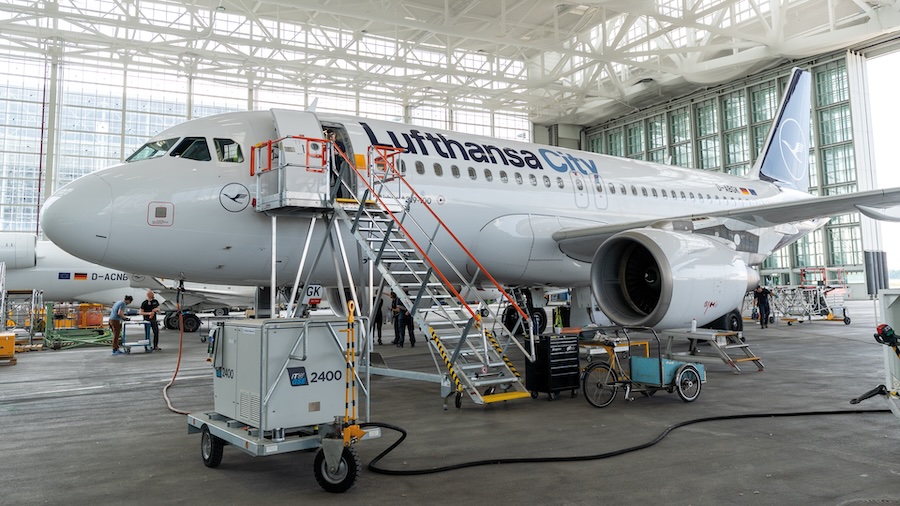

Lufthansa Group has launched flight trials of an upgraded version of its AeroSHARK fuel-saving surface technology, marking the first time the next-generation material is being evaluated on a short-haul aircraft.
The programme is being carried out by Lufthansa Technik and technology partner Surventis, with testing taking place on a Lufthansa City Airlines Airbus A319 operating scheduled flights between Munich and Hamburg through February 2027.
Testing New Areas of the Aircraft
The trial aircraft has been fitted with around 70 transparent test patches, each measuring 20 by 20 centimetres, attached to selected areas of the fuselage and engine cowlings.
Researchers will assess different material compositions under normal operating conditions to determine which combination offers the best durability, ease of maintenance and long-term performance.
The project is intended to support the development of AeroSHARK for use on wings, horizontal stabilisers and vertical tail surfaces, where aerodynamic loads are significantly higher than on the fuselage.
Inspired by Shark Skin

The film’s tiny grooves, around 50 micrometres high, are applied directly to the aircraft exterior, helping lower fuel burn and carbon emissions.
According to Lufthansa Group, the technology currently reduces fuel consumption and CO₂ emissions by around one percent on equipped aircraft.
Technology Already Deployed Across the Fleet
As of July 2026, AeroSHARK has been installed on 22 long-haul aircraft across the Lufthansa Group.
The fleet includes all 12 Boeing 777-300ERs operated by SWISS, five Boeing 777 freighters from Lufthansa Cargo, four Boeing 777-200ERs from Austrian Airlines, and one Boeing 747-400 operated by Lufthansa.

The airline group estimates these aircraft collectively save around 19 tonnes of fuel and 60 tonnes of CO₂ every day.
Lufthansa added that AeroSHARK is also being adopted by airlines outside the group as interest grows in technologies that improve aircraft efficiency and reduce emissions.