
Dubai Airports has published its first ESG Impact Report, bringing together environmental, social and governance priorities and results across Dubai International (DXB) and Dubai World Central – Al Maktoum International (DWC).
Covering 2024 and 2025, the report establishes an initial framework for tracking progress as the operator expands. It includes corporate performance and selected initiatives delivered with partners, organised under three pillars: Planet, People & Community, and Business.
The report is aligned with Airports Council International’s ESG Global Reporting Framework.
“Sustainability cannot sit on the sidelines of the business. It has to influence the choices we make, the way we operate and how we plan for the future,” said Paul Griffiths, CEO of Dubai Airports.
“We are clear about where we can make the greatest difference, from reducing the impact of our own operations to bringing partners together around the wider challenge of decarbonising aviation.”
Electricity Savings and Renewable Energy Plans
Dubai Airports reported a reduction in electricity consumption of 144.72 GWh against its 2019 baseline as of June 2025.
The report also highlights a 45 MWp rooftop solar programme across DXB and DWC, alongside the introduction of a 5% biodiesel blend across airport and partner vehicle fleets.
These initiatives sit within the operator’s Decarbonisation Strategy, established in 2023. It focuses on emissions associated with electricity, water, fuel and waste, with renewable energy, lower-carbon infrastructure and green mobility incorporated into future development plans.
The oneDXB Sustainability Alliance brings airport partners together to work on shared decarbonisation and sustainable aviation initiatives.
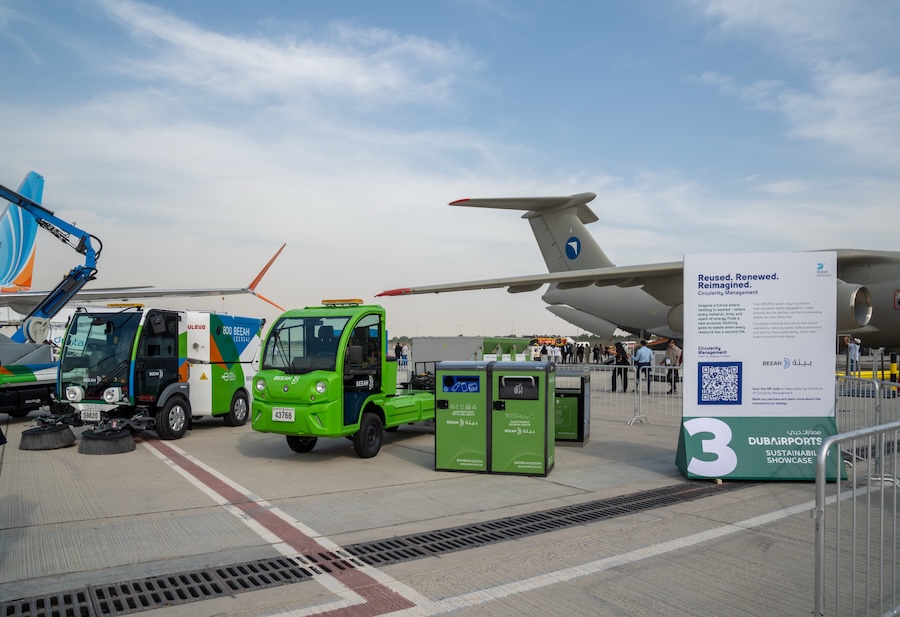
Waste Diversion Reaches 76% in 2025
Dubai Airports said it diverted 76% of its total waste from landfill in 2025. In a subsequent update beyond the report’s main reporting period, the operator said the diversion rate reached 100% in May 2026.
At DXB, seven food-waste digesters have a combined processing capacity of 4,900 kilograms per day. Broader efforts include increasing recycling and finding ways to keep materials in use.
Accessibility Training and Passenger Support
The report records eight dedicated accessibility services at DXB and 52,619 learners across 14 partner organisations completing accessibility training in 2025.
By the end of that year, 36,040 sunflower lanyards had been distributed to support passengers with hidden disabilities.
Staff development was another focus. During 2025, Dubai Airports delivered 24,115 hours of learning and leadership programmes to 1,531 employees, while extending development initiatives to 17,349 service partners.
Further Work on Data and Climate Planning
An updated governance framework introduced in 2025 strengthened oversight and accountability, according to the operator. ESG considerations are also being progressively incorporated into risk management and longer-term decisions.
The report identifies unfinished work, including improvements to data collection, completion of climate-risk and adaptation planning, further development of environmental management systems and closer collaboration with aviation partners.
“There are no quick fixes, and progress will require honesty, discipline, and sustained action across the entire aviation community,” said Griffiths.