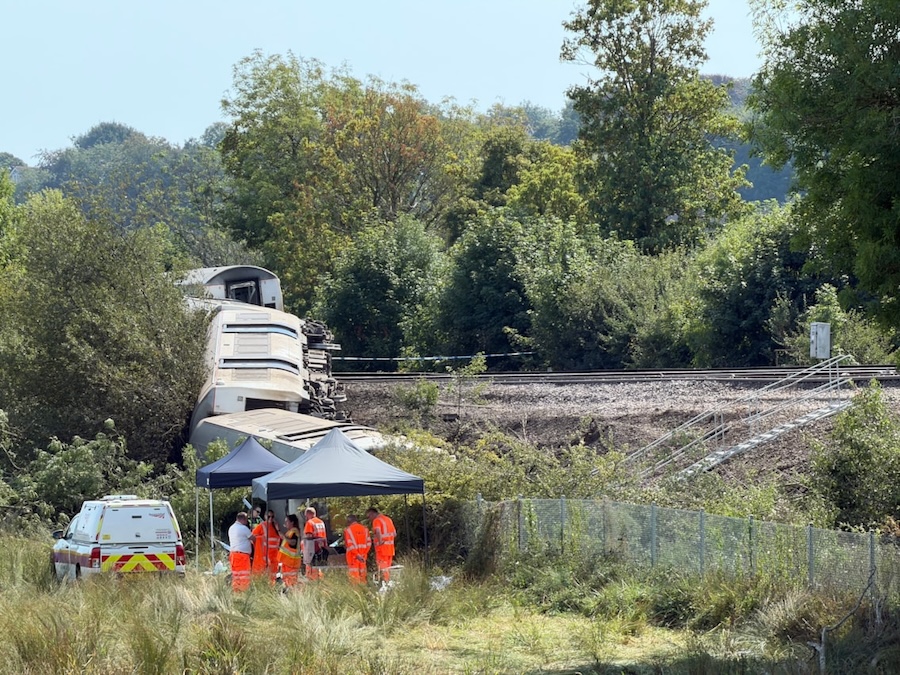

The railway between Lewes and Haywards Heath will remain closed for at least another ten days as Network Rail begins the recovery of a Southern train that derailed near Lewes on August 13.
Passengers travelling through Sussex over the coming days are being advised to check their journeys before departure and, where possible, use alternative train services via Brighton.
Replacement buses will operate between Lewes and Haywards Heath, stopping at Cooksbridge and Plumpton, although capacity will be limited.
The closure follows the derailment of a Southern service in which three carriages left the tracks and slid part-way down an embankment.
Lewes-Haywards Heath Line Closed for at Least 10 More Days
Network Rail and Southern have confirmed that the line will not reopen for at least another ten days while recovery teams remove the derailed train and assess damage to the railway.
Passengers making journeys beyond the stations served by replacement buses are being encouraged to travel via Brighton instead.
Tickets will be accepted on relevant alternative Southern, Thameslink and Southeastern services, as well as Brighton & Hove Buses and London Underground services between London terminal stations.
Passengers who decide to postpone their journey until the line reopens will also be able to use their existing ticket at a later date.
Passengers Advised to Check Journeys Before Travel
Journey planning systems are being updated at least one day in advance, meaning schedules may continue to change as the recovery progresses.
Passengers should therefore check live travel information before beginning their journey, particularly if travelling through Lewes, Haywards Heath, Cooksbridge or Plumpton.
Replacement buses will serve:
- Lewes
- Cooksbridge
- Plumpton
- Haywards Heath
Due to limited capacity on these buses, passengers making other journeys are advised to use trains via Brighton where possible.
Major Recovery Operation Begins Near Lewes
The Rail Accident Investigation Branch (RAIB) completed its on-site work on Saturday and has handed the location back to Network Rail.
RAIB’s investigation into the derailment itself is continuing.
Network Rail has now begun what it describes as a complex train recovery operation, with three derailed carriages requiring removal from the embankment.
The location presents several challenges. The railway runs close to a river and through a Site of Special Scientific Interest, while road access to the site is restricted and passes through a residential area.
As a result, Network Rail is transporting as much specialist equipment as possible to the site by rail rather than road.
Two 125-Tonne Cranes Required to Recover Derailed Carriages
Engineers are preparing the site for two 125-tonne rail-mounted cranes, among the largest cranes available for railway operations.
Before the lifting operation can begin, teams must confirm that both the ground and railway infrastructure are sufficiently stable to support the cranes as well as the weight of the derailed carriages.
The three vehicles will then be carefully lifted away from the embankment.
Only after the train has been removed will engineers be able to fully inspect the infrastructure and determine the extent of repairs required before passenger services can safely resume.
Southern Provides Alternative Transport During Closure
Greater Thameslink Railway, which operates Southern, said additional staff are being deployed to stations while replacement transport is provided for affected passengers.
John Whitehurst, Chief Executive Officer of Greater Thameslink Railway, said:
“It has been an incredibly difficult time for our customers and colleagues, and our thoughts remain with everyone affected by this, particularly the family and friends of those who have been injured.
“We recognise the impact this incident will have on customers’ journeys in the days ahead, and we’re working closely with Network Rail to do everything we can to keep customers moving while recovery work continues and the railway is restored safely. We know this recovery effort is not only affecting rail customers, but also local communities around Lewes, and I’d like to thank them for their patience and understanding while our teams work to restore the railway.
“We’re providing replacement transport where needed and deploying additional colleagues at stations to support customers and help them complete their journeys. I thank customers for their patience and understanding while the railway recovers from this incident.”
Network Rail Working Around the Clock to Restore the Line
Network Rail is working with Lewes District Council and other local partners during the recovery operation.
The combination of nearby homes, restricted access and the environmentally sensitive location means the removal of the train must be carefully managed before repairs can begin.
Lucy McAuliffe, Network Rail’s Sussex Route Director, said:
“This is a complex recovery operation in a very difficult location, and our teams are working hard to recover the carriages and repair the railway, to resume services safely as soon as we can.
“We know the closure is disruptive and the recovery work also affects people living close to the railway. I’m grateful for the support and understanding of the local community while we carry out this work, and for the patience of our customers during this time. We are working around the clock to get this done. We will share more updates as the recovery work progresses.”
When Will the Lewes-Haywards Heath Line Reopen?
At this stage, Network Rail has not announced a confirmed reopening date.
The line will remain closed for at least ten more days, but the final timetable will depend on what engineers find after the derailed carriages have been removed and the railway can be fully inspected.
Passengers travelling in the area in the coming weeks should continue to check their journey before departure and allow additional time where replacement transport is required.