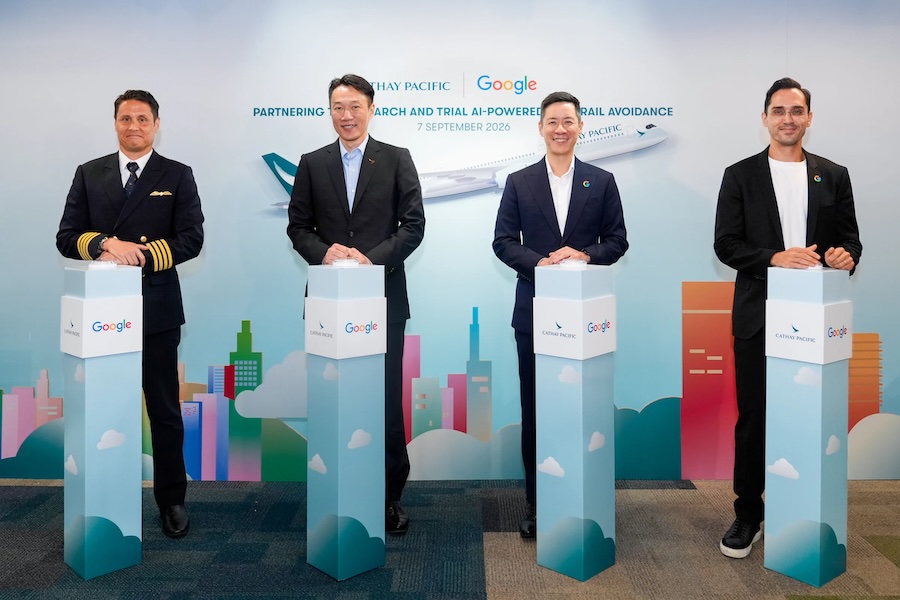

Cathay Pacific and Google have partnered to test AI-powered contrail avoidance technology across the airline’s international network, with early trials showing a significant reduction in the warming impact associated with aircraft condensation trails.
Cathay Pacific is the first commercial airline in the Asia-Pacific region to trial Google’s contrail mitigation technology and, according to the companies, the first airline globally to test contrail avoidance on ultra-long-haul flights.
The project combines artificial intelligence, weather data and satellite imagery to identify atmospheric conditions likely to produce persistent contrails. Flight crews can then make relatively small altitude adjustments to avoid those areas when operational conditions allow.
More than 80 flights tested contrail avoidance
An initial operational trial began in late 2025, targeting more than 100 Cathay Pacific flights.
More than 80 of those flights ultimately followed contrail-avoidance routes, with some flights unable to participate because of factors including airspace and payload restrictions.
According to Google estimates, the participating flights achieved an approximately 40% reduction in the warming impact of contrails.
One of the routes included in the trial was Hong Kong-Singapore, where atmospheric conditions frequently allow persistent contrails to form. Early analysis found that relatively minor altitude changes could prevent their formation.
Actions taken on the Hong Kong-Singapore route alone accounted for more than half of the total climate impact achieved during the initial trial, according to the companies.
How Google’s AI contrail technology works
Contrails, short for condensation trails, are the white lines that can form behind aircraft flying through cold and humid air at high altitude.
Many disappear relatively quickly, but others can persist and spread into larger cloud formations. These persistent contrails can trap heat in the atmosphere and contribute to aviation’s overall warming effect.
Research cited by Cathay Pacific and Google suggests persistent contrails could account for around one-third of aviation’s total climate impact, making non-CO₂ effects an increasingly important area of aviation climate research.
Google’s technology uses AI-based prediction models, satellite imagery and weather intelligence to forecast areas where contrails are likely to form.
The resulting information is provided to flight dispatchers and pilots, who can consider altitude changes to avoid these areas in a similar way to operational adjustments already made for weather and turbulence.
Cathay Pacific brings contrail forecasts into the cockpit
Cathay Pacific has integrated Google’s contrail forecasts with technology already available across its modernised fleet.
Pilots receive the forecasts through the airline’s internally developed Electronic Flight Folder, or EFF, which combines in-flight connectivity with real-time operational information.
The objective is to allow pilots to consider contrail avoidance alongside other flight parameters without significantly disrupting normal operations.
“Aviation needs solutions to address climate change, and AI is accelerating that progress,” said Lawrence Fong, Director Digital and IT at Cathay. “This partnership combines Cathay’s operational expertise with Google’s world-class AI capabilities to tackle complex sustainability challenges at scale.”
Michael Yue, Managing Director and General Manager of Google Hong Kong, said the project is exploring how predictive AI can be applied to live airline operations using existing aircraft and fuels.
Second phase will cover Asia and transpacific flights
Following the results of the first phase, Cathay Pacific and Google are now planning a larger series of flight trials.
The next stage will include flights across Cathay Pacific’s Asian and transpacific network, giving researchers a larger and more geographically diverse set of operational data.
The Asia-Pacific region is particularly relevant to the research because it has been underrepresented in previous real-world contrail avoidance trials.
Contrails.org, a nonprofit initiative focused on advancing contrail mitigation science, is also participating in the project.
The partners caution that the initial results apply to individual flights and that additional research is required before the effectiveness and operational implications of large-scale contrail avoidance can be established.
The expanded trials will examine factors such as airspace restrictions, payload requirements and the practical challenges of incorporating altitude changes into routine airline operations.
For Cathay Pacific, contrail research will complement rather than replace efforts to reduce direct carbon dioxide emissions. The airline continues to focus on fleet modernisation, operational efficiency and sustainable aviation fuel while studying ways to address aviation’s non-CO₂ climate effects.
The longer-term goal of the project is to build a larger real-world dataset that could help airlines, researchers and regulators determine whether contrail avoidance can become a practical climate mitigation measure across commercial aviation.