
Brussels Airport has expanded the capabilities of its airport fire service with four new specialised firefighting vehicles and a training simulator, investing almost €6 million in emergency response and operational safety.
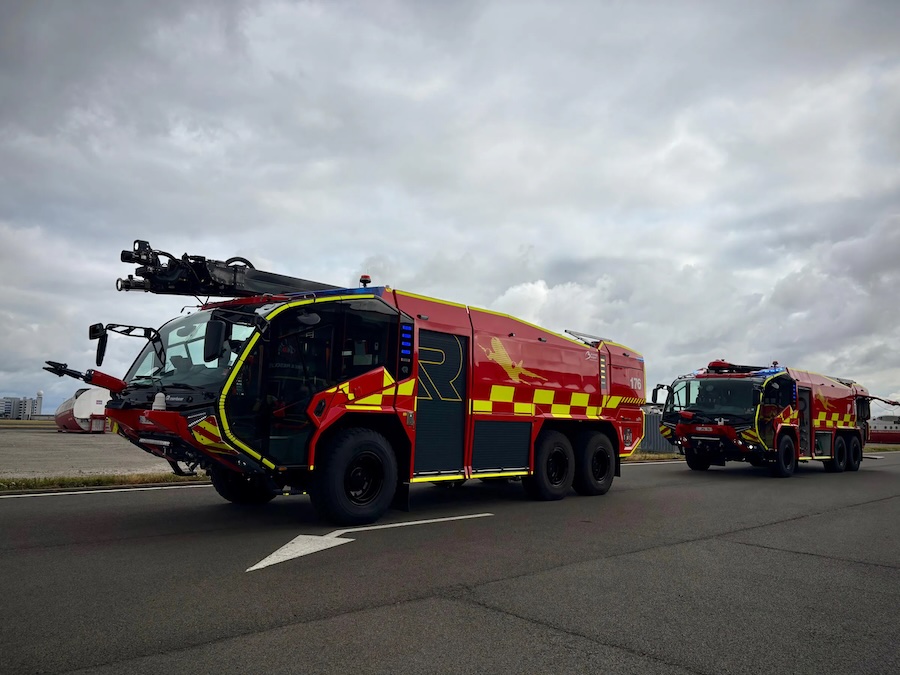
The airport’s in-house fire service has put four new Rosenbauer crash tenders into operation, replacing five older vehicles that had reached the end of their service life.
Designed specifically for rapid intervention on airport runways and airfields, each new vehicle weighs 39 tonnes and can reach a top speed of 115 km/h.
New Crash Tenders Carry Up to 12,500 Litres of Water
Each crash tender can carry 12,500 litres of water, 1,500 litres of firefighting foam and 225 kilograms of dry powder.
Roof-mounted water cannons can discharge up to 5,200 litres of water per minute, allowing firefighters to quickly deploy large quantities of extinguishing agents during an aircraft emergency.
One of the new vehicles is also equipped with a steel piercing nozzle. The system allows firefighters to penetrate an aircraft fuselage and inject extinguishing agents directly into the cabin or cargo hold when necessary.
According to Brussels Airport, the new crash tenders comply with safety standards established by the International Civil Aviation Organization (ICAO) and the European Union Aviation Safety Agency (EASA).
New Simulator Provides Realistic Emergency Training
Alongside the vehicles, Brussels Airport has acquired a specialised driving simulator for training firefighters who will operate the new crash tenders.
The simulator features the same cab configuration as the new vehicles and allows crews to practise driving and responding to realistic airport emergency scenarios in a controlled environment.
The four crash tenders and simulator together represent an investment of nearly €6 million.
Firefighters Must Reach Airfield Incidents Within Three Minutes
Brussels Airport’s fire service employs around 150 people and operates 24 hours a day, seven days a week.
Teams respond to a range of situations, including aircraft emergencies, medical incidents, fire alarms and preventive interventions.
Firefighting vehicles are also placed on standby when an arriving aircraft reports a technical problem that could require an emergency response after landing.
In the event of an incident on the airfield, airport firefighters are required to reach the scene within three minutes, with at least three crash tenders responding.
To meet these response requirements, Brussels Airport operates two fire stations positioned on opposite sides of the airport.
For emergencies inside airport buildings, including the passenger terminal, the maximum response time is five minutes.
Following the latest additions, Brussels Airport’s fire service operates a fleet of approximately 25 specialised vehicles.
The fleet includes six crash tenders as well as aerial ladder vehicles, pumping appliances, an evacuation stair vehicle and a firefighting robot designed to operate in areas that may be difficult or dangerous for firefighters to access.