
Lufthansa Technik has entered the final certification phase for its AeroSHARK drag-reducing technology on the Airbus A330, marking the first time the shark skin-inspired surface film has been tested for certification on an Airbus aircraft.
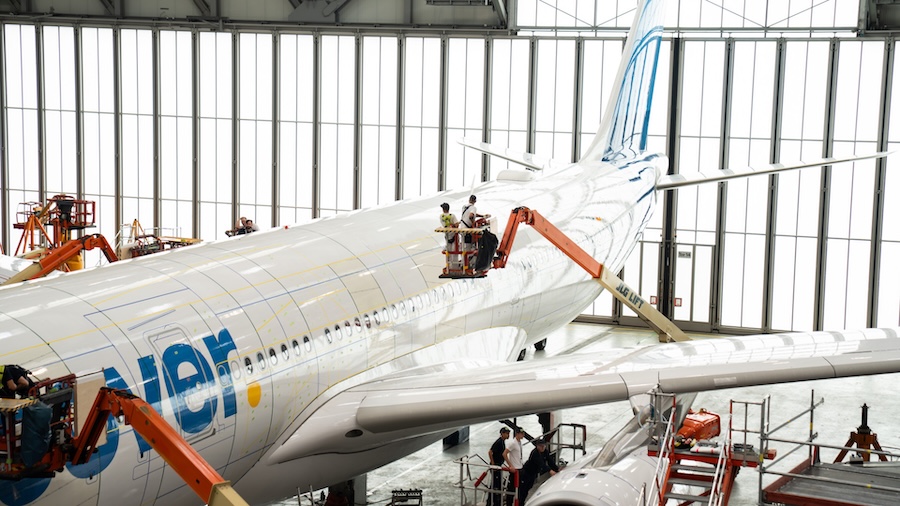
A Discover Airlines A330-300 is being used for the programme, with a series of test flights taking place before and after the aircraft is modified at Elbe Flugzeugwerke in Dresden.
If approved, the Supplemental Type Certificate will allow AeroSHARK to be installed on both the Airbus A330-200 and A330-300.
The certification programme is being conducted with the European Union Aviation Safety Agency (EASA).
AeroSHARK moves from Boeing 777 to Airbus A330
Developed by Lufthansa Technik and Surventis, formerly BASF Coatings, AeroSHARK uses microscopic structures inspired by the surface of shark skin to reduce aerodynamic drag.
The film contains tiny grooves known as riblets, measuring approximately 50 micrometers in height and aligned with the direction of airflow.
Applied to areas including an aircraft’s fuselage and engine cowlings, the surface reduces frictional drag during flight. Lufthansa Technik says the current version of the technology can reduce fuel consumption and CO₂ emissions by around 1%.
While the saving on an individual flight is relatively small, it can become significant when accumulated across thousands of long-haul flights over an aircraft’s operational life.
AeroSHARK is already certified for several Boeing 777 variants, including the 777F, 777-300ER and 777-200ER.
Certification for the A330 would substantially expand the number of aircraft potentially able to use the technology, given the model’s large presence in long-haul fleets worldwide.
Discover Airlines A330 used for flight testing
Lufthansa Technik entered the final certification phase for the A330-200 and A330-300 at the end of August 2026.
The Discover Airlines aircraft involved in the programme will undergo several weeks of testing, including flights performed before and after the AeroSHARK modification.
The certification process includes technical documentation, ground and flight testing and final validation under normal airline operating conditions.
“AeroSHARK is an excellent example of how innovations from the Lufthansa Group can make concrete contributions to greater efficiency and lower emissions,” said Grazia Vittadini, Chief Technology Officer of Lufthansa Group.
“With the planned certification for the Airbus A330ceo, we are tapping into the potential of another significant portion of the global long-haul fleets.”
Mastercard is also supporting the current phase of the AeroSHARK project as part of a sustainability-focused strategic partnership with Lufthansa Group.
22 Lufthansa Group aircraft already use AeroSHARK
As of August 2026, 22 aircraft in the Lufthansa Group fleet had been equipped with AeroSHARK.
According to the group, these aircraft collectively save approximately 19 metric tonnes of kerosene and around 60 metric tonnes of CO₂ per day.
The technology is also being used by airlines outside Lufthansa Group on compatible Boeing 777 aircraft.
Lufthansa Technik and Surventis are now working on a next-generation version of AeroSHARK that could be applied to additional parts of an aircraft.
Future applications could include wings and tail surfaces, potentially doubling the fuel and emissions savings compared with the current configuration.
The Airbus A330 certification therefore represents both an expansion of AeroSHARK to another major long-haul aircraft family and another step toward applying the technology across larger portions of an aircraft’s external surface.