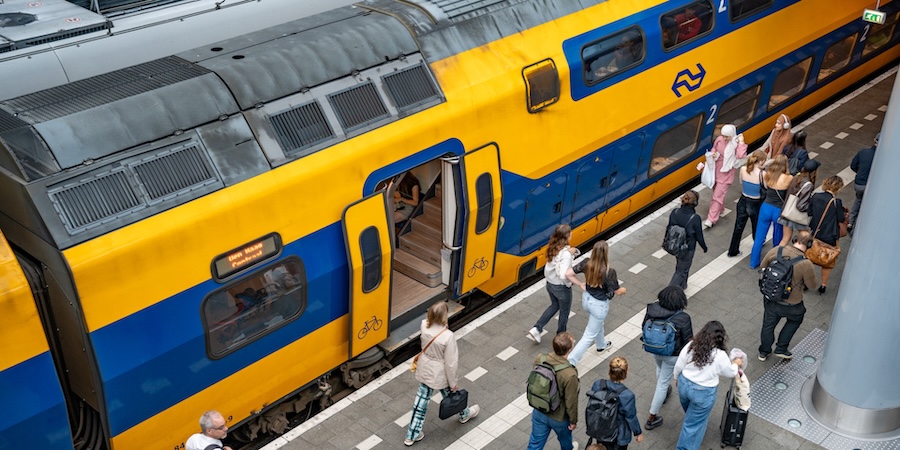

Dutch railway operator NS is offering discounted fares to passengers who choose less crowded trains during the edges of peak hours, as it prepares for September, traditionally the busiest month of the year on the Netherlands’ rail network.
The discounts will be available through NS’s PrijsTijd Deals on selected services where additional capacity remains available.
September traffic is particularly heavy during Tuesday and Thursday rush hours. NS hopes that encouraging even a relatively small proportion of passengers to shift their journeys could significantly reduce overcrowding on the busiest services.
Tickets eligible for a PrijsTijd Deal must be purchased at least one day before travel.
Small changes could free up seats on busy trains
According to NS, shifting only a small percentage of passengers between services can sometimes be enough to ensure seats are available for everyone.
The railway operator gives the example of a Tuesday morning Sprinter departing Den Haag Mariahoeve towards Leiden Centraal at 07:46.
If 6% of passengers switched to the quieter service departing 15 minutes earlier, NS estimates that all passengers on both trains could have a seat.
A similar situation applies to the 08:49 Intercity from Zwolle to Amersfoort. NS says that if 8% of its passengers travelled on the Intercity departing half an hour later, seating capacity would be sufficient on both services.
The company argues that this approach also helps passengers who cannot adjust their schedules, as fewer discretionary travellers on the busiest services leave more space for those who need to travel at a specific time.
One in five passengers willing to switch for a discount
NS tested the concept in 2025 and found that around one in five passengers would consider choosing a quieter train if offered a fare discount.
Many were prepared to adjust their departure by as much as 30 minutes.
“NS, like electricity grid operators for example, has to deal with peak loads,” said Tijmen Voet, Director of Timetabling at NS.
“But if a small percentage of passengers choose a less busy alternative, passengers will have to stand much less often on trains.”
Voet said spreading demand also reduces the need to deploy particularly long trains for relatively short periods of peak demand, only for those trains to operate with substantial unused capacity during quieter parts of the day.
Longer trains planned on several Dutch routes
NS will increase train lengths across the Netherlands during the autumn timetable, with passengers on several corridors expected to see additional capacity.
The changes will be particularly noticeable on services between Alkmaar and Utrecht, Utrecht and Nijmegen, and Rotterdam and Leiden.
At the same time, NS is changing the way it allocates rolling stock in response to disruptions across the Dutch rail network.
Major disruption increased by more than 25% during the first half of 2026 compared with the same period in 2025, according to the operator.
These incidents can disrupt planned rolling stock rotations, resulting in shorter trains appearing on heavily used services while longer trains operate routes with lower demand.
NS moves towards more standardised train lengths
To reduce the impact of these disruptions, NS plans to operate more services with standardised train formations.
Some of the longest trains could be shortened slightly, for example from ten to eight carriages, while shorter formations could increase from six to eight.
The aim is to reduce the risk of an unexpectedly short train appearing on a busy service following disruption, providing more consistent capacity across the network.
NS is also changing its maintenance schedules to make more trains available on the busiest days of the week. Where possible, maintenance work will be moved to quieter days, increasing the number of seats available during periods of high demand.
The operator says the approach could also allow some older, maintenance-intensive trains to remain available as reserve capacity rather than being required for regular peak operations.
The combination of discounted off-peak-edge travel, adjusted train lengths and revised maintenance scheduling forms part of NS’s strategy to manage demand during September without simply adding maximum capacity across the network throughout the entire day.