
Copenhagen Airport is launching CPH Air Lab to test whether filtration technologies can capture ultrafine particles from aircraft emissions close to their source.
Located within active airside operations, the facility will assess five technologies over the coming months. The trials expand the airport’s air-quality work beyond reducing emissions to investigating whether pollution can also be removed from the air.
Five Filtration Technologies Under Review
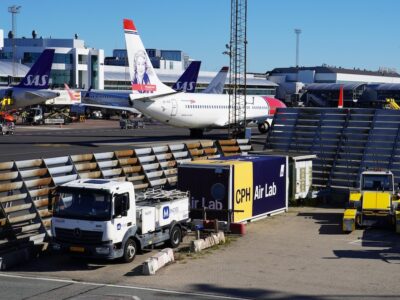
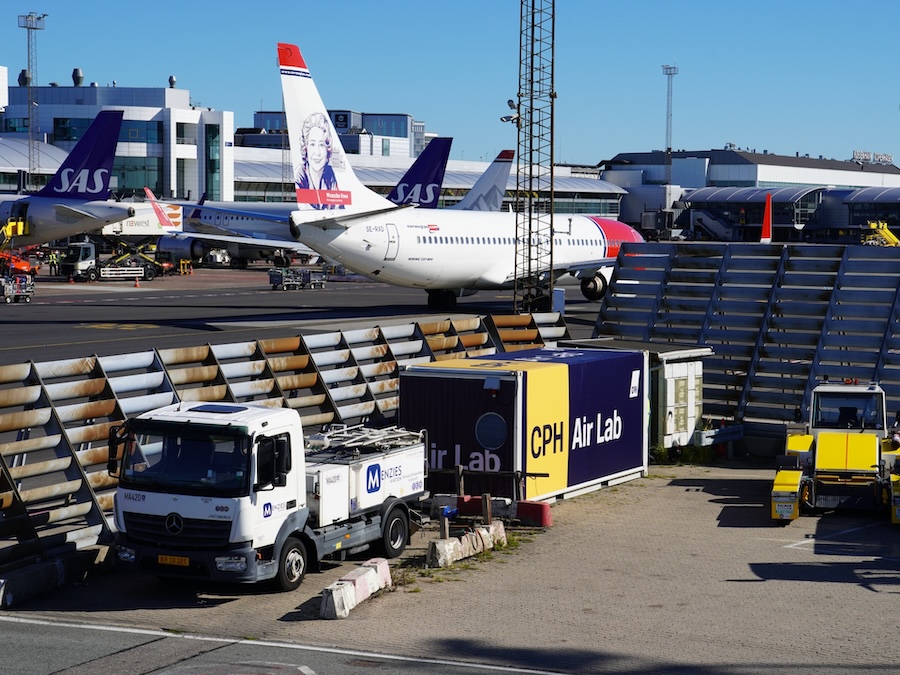
CPH Air Lab is housed in a container fitted with a large ventilation duct, a test chamber and sensors that measure airborne particles.
The technologies use different methods to capture pollutants, including mechanical filters, electrically charged surfaces and biological materials such as moss.
All were originally developed for other industries. Testing them with aircraft exhaust in an operational airport will help establish how well they perform under these conditions.
Alexandra Halberg Hüneburg-Møller, a project manager in Copenhagen Airport’s innovation team, said the facility provides an opportunity to evaluate those systems in the environment where they could eventually be used.
Airport Blast Fences Could Become Test Sites
The best-performing technologies will be considered for larger-scale trials next year, including possible integration into blast fences. These barriers protect surrounding areas from the powerful airflow generated by aircraft engines.
Further testing will examine whether the filters remain effective in open-air conditions. If successful, potential applications could include air-cleaning systems built into blast fences or building façades.
The airport stresses that CPH Air Lab is a testing programme, rather than a finished pollution-control solution.
Copenhagen and Schiphol Share Research
The laboratory forms part of the Accelerate Sustainable Aviation Programme, or ASAP, a joint initiative between Copenhagen Airport and Amsterdam Airport Schiphol.
The programme allows the airports to develop and test solutions together, share findings and gather evidence to inform future investment decisions.
Maria Skotte, Copenhagen Airport’s Chief Sustainability Officer, said the filtration trials build on years of work to reduce ultrafine particle emissions, with a focus on air quality for employees and neighbouring communities.
Reducing Emissions From Parked and Taxiing Aircraft
The airport’s existing measures include thermal imaging cameras and artificial intelligence to monitor aircraft use of auxiliary power units, known as APUs.
Copenhagen provides electricity and pre-conditioned air at aircraft stands, reducing the need to run APUs while aircraft are parked.
Pilots are also encouraged to taxi using a single engine where operationally feasible. Airport development plans aim to minimise taxi distances, helping reduce fuel consumption and associated emissions.
The new laboratory will assess whether filtration can complement these measures as Copenhagen prepares to accommodate more passengers.