
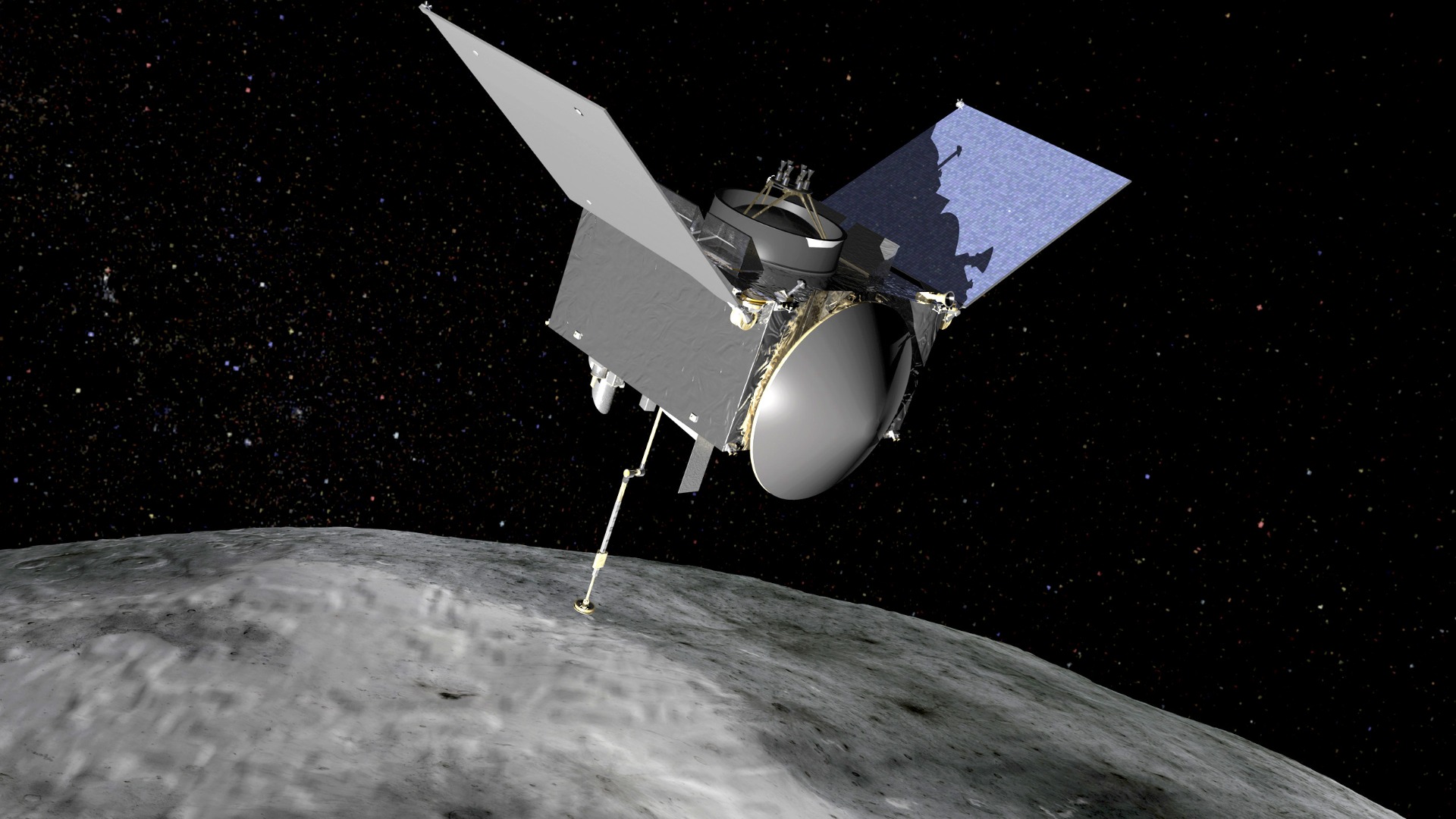
Touchdown in Utah: OSIRIS-REx Sample Just Landed
A capsule from a NASA spacecraft gracefully touched down in the Utah desert on September 24, successfully wrapping up a remarkable seven-year endeavor to retrieve samples from a nearby asteroid.

The sample return capsule, hailing from the Origins, Spectral Interpretation, Resource Identification, and Security-Regolith Explorer (OSIRIS-REx) spacecraft, made its impressive landing at the Utah Test and Training Range at precisely 10:52 a.m. Eastern Time. This momentous arrival occurred a mere 10 minutes after the capsule, hurtling through the Earth's atmosphere at a breathtaking speed of 44,500 kilometers per hour, detached from the main spacecraft.
Astoundingly, the landing transpired three minutes ahead of the planned timeline for the capsule's return. NASA explained during the live landing broadcast that the primary parachute opened at a considerably higher altitude than anticipated, soaring to around 6,000 meters instead of the expected 1,500 meters.
In a post-landing press briefing, project officials candidly revealed that while a drogue parachute was deployed prior to the main parachute, there was a lack of visual confirmation regarding the drogue's inflation performance.
“Something in our sequence may or may not have behaved itself exactly the way we expected it to, but the subsequent things in the sequence made up for it,” remarked Tim Priser, the chief engineer for deep space exploration at Lockheed Martin, the entity responsible for constructing the OSIRIS-REx spacecraft. “At the end of the day, when that main chute deployed, it basically corrected anything that may have happened ahead of it.”
The capsule touched down roughly eight kilometers from the center of the final landing ellipse, which measured 12 by 30 kilometers, according to Mike Moreau, the deputy project manager for the mission at NASA's Goddard Space Flight Center. This minor deviation was well within expectations, as atmospheric variations forecasted a landing east of the center.
Upon landing, the capsule proved to be in impeccable condition, as Dante Lauretta, the principal investigator for OSIRIS-REx at the University of Arizona, attested. He was part of the team responsible for recovering the capsule and observed, “There was no sign of any damage or distortions of the heat shield and backshell that we could see. We pretty much stuck the landing,” he mentioned.
The recovery team transported the capsule to a temporary clean room at the Dugway Proving Ground for preliminary work involving the removal of the capsule's heat shield and backshell. Eileen Stansbery, the chief scientist at the Johnson Space Center, reported that there were no indications during this initial phase that any of the asteroid samples, contained within the capsule, had escaped.
NASA initiated the OSIRIS-REx mission in September 2016, utilizing an Atlas 5 rocket for launch. The spacecraft reached its destination, the asteroid Bennu, in 2018. After conducting meticulous observations of the asteroid's surface from orbit, scientists identified a location on Bennu's surface for a daring "touch and go" maneuver. During this maneuver in October 2020, the spacecraft descended to the surface, briefly inserting a sampling device to collect material from the asteroid before retreating.
The sampling operation proved exceedingly successful, collecting an abundance of material from Bennu. In response, engineers expedited the stowage of the sample container into the return capsule after detecting some material leakage into space through images. Project officials disclosed that while they were unable to quantify the material in the sample canister, they believed it vastly exceeded the mission's requirement of 60 grams, estimating the capsule contained 250 grams of material, plus or minus 101 grams. “Even at the low end of that end estimate, we’re well above our mission requirements,” noted Lauretta.
The sample container is scheduled for transport to a curation facility at the Johnson Space Center on September 25. Once there, scientists will embark on a meticulous process of extracting the samples to preserve their integrity for scientific study. However, NASA cautioned that this effort may be postponed in the event of a federal government shutdown due to funding lapses on October 1.
Lauretta disclosed during the post-landing briefing that initial sample analysis could commence as early as September 26, following the opening of the canister and the collection of surface dust.
The primary OSIRIS-REx spacecraft, following a maneuver executed 20 minutes post-capsule separation to ensure its safe passage past Earth, will now embark on an extended mission christened OSIRIS-APEX. Its destination: another near-Earth asteroid named Apophis, with an arrival timeline shortly after the asteroid's Earth flyby in 2029.
As for Lauretta, he will remain steadfastly dedicated to analyzing the mission's collected samples—a mission that has been a part of his life for nearly two decades, beginning with the proposal of an asteroid sample return mission by Lockheed Martin and the University of Arizona. “It was like meeting an old friend that I hadn’t seen for a long time," he reflected on encountering the capsule after its landing. "I knew we had done it. We had pulled it off."
Source: spacenews.com

Latest Articles