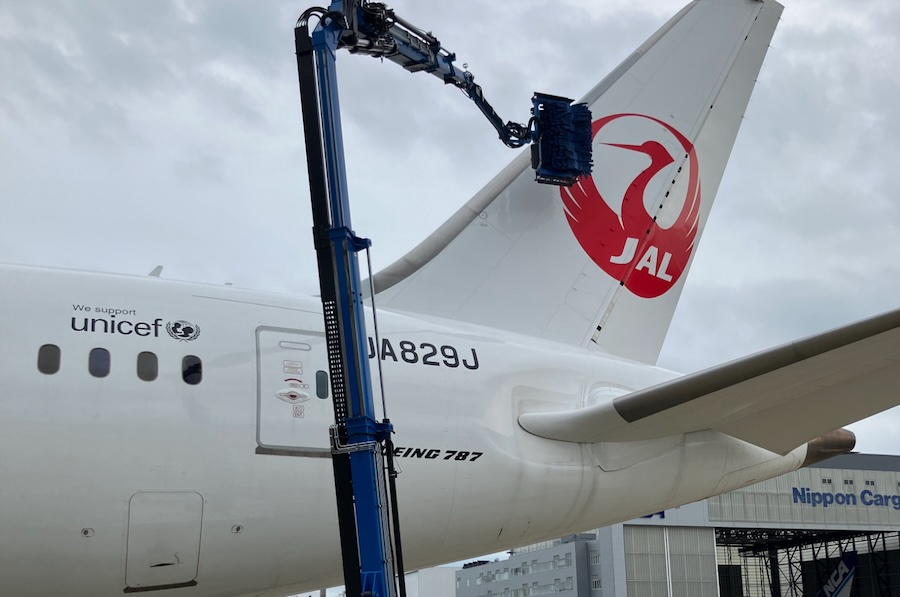

Japan Airlines (JAL) is introducing a program-controlled aircraft washing robot at Narita Airport as part of its wider push to automate and modernise ground handling operations.
The airline will deploy the Aerowash AW3, a remote-controlled washing system capable of automatically positioning its robotic arm around different sections of an aircraft.
According to JAL, the deployment represents the first use by a Japanese airline of a collaborative aircraft washing robot featuring programmed automatic approach functions for individual aircraft types and multi-axis control.
Following operational training, JAL plans to move to full-scale use of the system during 2026.
Robot Combines Automation with Human Control
Rather than completely automating the aircraft washing process, the AW3 is designed around cooperation between the machine and its operator.

Coordinates for different aircraft surfaces are programmed into the system, allowing the robotic arm to automatically approach areas including the wings and tail.
Once the equipment is close to the aircraft, an operator uses handheld controls to make more precise adjustments before washing.
The robot also features an omnidirectional four-wheel-steering system, allowing it to manoeuvre and position itself around aircraft more easily.
JAL says the combination of automated positioning and manual fine control is intended to reduce labour requirements while maintaining the safety standards necessary when operating equipment close to an aircraft.
Aircraft Washing Time Could Fall by 40%
Aircraft exterior cleaning has traditionally been a labour-intensive operation, often carried out overnight using long-handled mops and specialist cleaning products.
JAL previously experimented with a wired remote-controlled washing system around 30 years ago, but technical limitations prevented the technology from remaining in long-term use.
The AW3 represents the airline’s first major attempt to introduce program-controlled aircraft washing since then.
According to manufacturer Aerowash, the system can reduce the time required to wash an aircraft by as much as 40% compared with conventional manual methods.
JAL plans to evaluate those performance claims during real-world operations at Narita before determining the longer-term impact on ground handling productivity.
JAL Targets Safer Working Conditions
Automation could also reduce some of the physical demands associated with aircraft exterior cleaning.
Manual washing can involve working at height, repetitive movements and handling cleaning chemicals during overnight operations.
By transferring more of the physical washing process to the robot, JAL expects to reduce employee strain and direct exposure to cleaning agents.
The project forms part of the airline group’s Airport Digital Transformation strategy, which is focused on using new technology to improve the safety, productivity and working environment of airport operations.
Water Consumption Could Be Cut by Half
JAL is also highlighting the potential environmental benefits of the new system.
Aerowash estimates that its technology can reduce water consumption during aircraft washing by up to 50%.
The AW3 is fully electric and battery powered, eliminating direct CO2 emissions from the machine while it is operating at the airport.
Both the 40% washing-time reduction and 50% water-saving figures are based on manufacturer specifications rather than JAL’s own operational results. The airline plans to assess actual performance as use of the robot expands.
JAL Could Expand Aircraft Washing Robots Beyond Narita
Narita Airport will serve as the starting point for the programme, but JAL is already considering deploying the technology at other airports in Japan.
The airline will use its experience at Narita to evaluate improvements in washing quality, productivity, employee working conditions and resource consumption.
The project is part of a wider effort by JAL to introduce automation into ground handling while maintaining human oversight in operations where safety and precision remain critical.