
Brussels Airport has started testing an autonomous electric tow tractor in its cargo zone as part of a European project exploring how self-driving technology could improve the efficiency and sustainability of airport logistics.
The pilot is being carried out with WFS Cargo and Charlatte Autonom, a joint venture between Charlatte Manutention and autonomous driving specialist Navya Mobility.
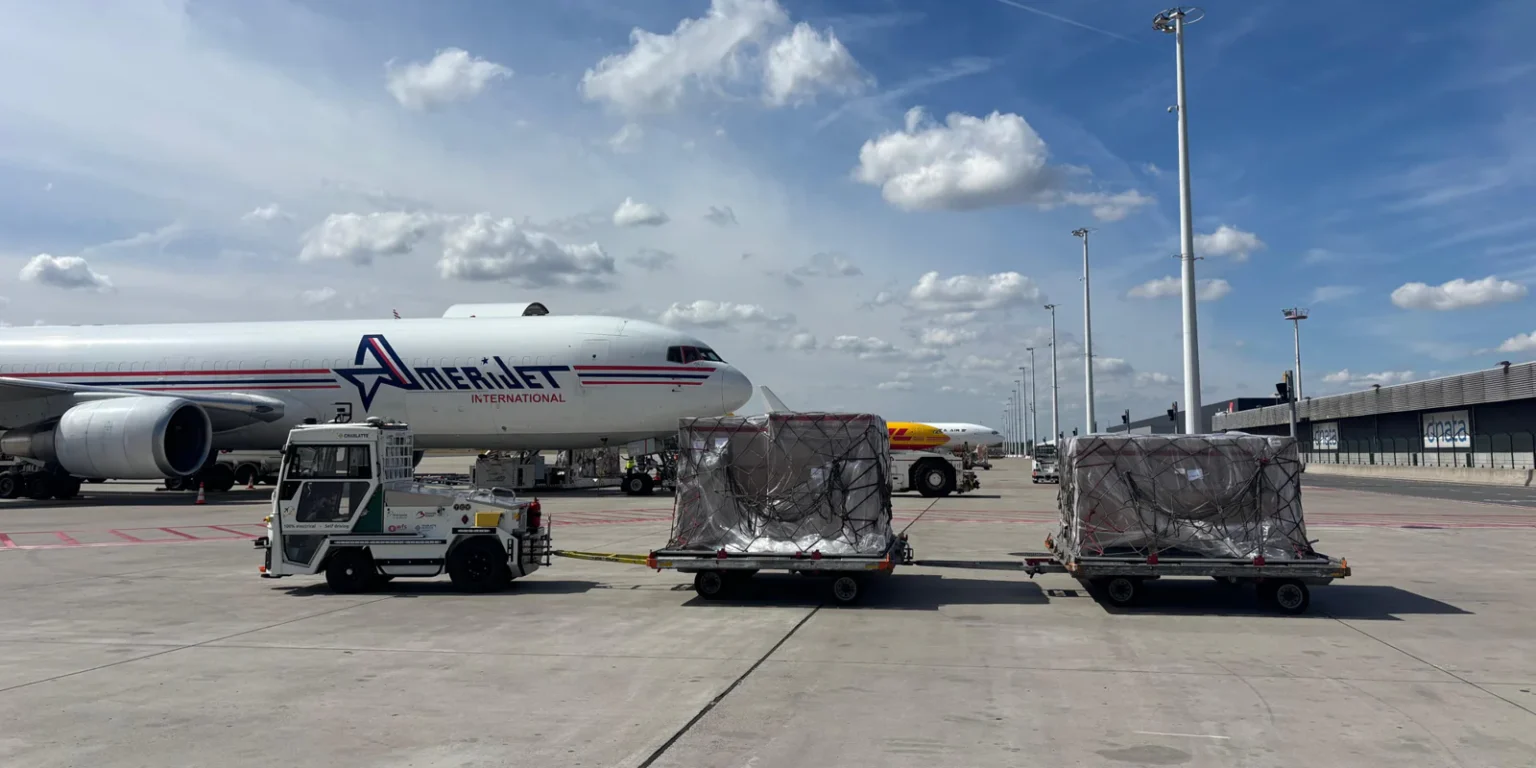
During the trial, the electric vehicle transports cargo trailers along predefined routes between warehouses and operational areas, including airport aprons.
The project forms part of Stargate, a European Commission-backed programme led by Brussels Airport to develop and test technologies aimed at making aviation more sustainable.
“At Brussels Airport, we continue to explore innovative and sustainable solutions that can tangibly strengthen cargo operations,” said Arnaud Feist, CEO of Brussels Airport.
“Thanks to this project, we can gain valuable insights into the potential of autonomous technologies, and into what they can deliver in terms of efficiency and sustainability, while people remain key to operations and the highest safety standards are maintained.”
Autonomous tractor can tow four cargo trailers
The vehicle uses a combination of satellite navigation and laser sensors to determine its position, detect obstacles and navigate through the airport environment.
Navya Mobility’s autonomous driving software manages the vehicle’s route and is designed to operate in areas where autonomous equipment shares space with conventional vehicles and other airport operations.
For the current trial, four predefined routes have been established within Brussels Airport’s cargo zone.
The tractor can tow up to four cargo trailers during testing, with its maximum speed in autonomous mode limited to 12 km/h.
One of the scenarios involves transporting cargo between warehouses and airport aprons, allowing the partners to assess how the system performs in realistic operational conditions.
Operator remains onboard during testing
Although the tractor is capable of autonomous movement, a trained operator remains onboard throughout the current phase of testing.
The operator supervises the vehicle and can intervene immediately if required.
Tests are also being conducted during off-peak periods and under controlled conditions to minimise interaction with regular airport traffic while the technology is evaluated.
The vehicle carries CE marking under the applicable Machinery Directive requirements.
Safety will be a central consideration in determining whether autonomous cargo tractors could eventually be introduced on a larger scale at the airport.
“This project with Brussels Airport once again illustrates the expertise of Charlatte Manutention and Navya Mobility in deploying autonomous mobility solutions within complex and demanding airport environments,” said Jean-Claude Bailly, CEO of Navya Mobility.
Bailly said the technology is designed to support fully autonomous operation without an onboard operator when regulations and operating conditions allow.
WFS Cargo employees being trained on autonomous technology
WFS Cargo, one of the cargo handling companies operating at Brussels Airport, is participating in the trial.
Several WFS employees are being trained to work safely alongside and operate with the autonomous tractor during the testing programme.
The partners will use the trial to assess how the technology can be integrated into existing cargo workflows and what infrastructure, operational procedures and regulatory conditions would be necessary for a broader deployment.
The aim is not only to automate vehicle movements but also to determine whether the technology can reduce inefficiencies in cargo transportation while supporting existing airport teams.
Brussels Airport continues autonomous vehicle trials
The project follows an earlier autonomous mobility experiment conducted at Brussels Airport in 2024.
That trial examined the potential use of a self-driving shuttle to transport airport employees.
The latest project shifts the focus from passenger and staff mobility to cargo logistics, where repetitive movements between warehouses and aircraft operating areas could provide a practical application for autonomous vehicles.
Brussels Airport is one of Europe’s important air cargo hubs, making its cargo zone a potentially useful testing environment for technologies that could later be adopted at other airports.
Trial forms part of EU-backed Stargate programme
The autonomous tractor project is one of several initiatives being developed under Stargate, which was selected by the European Commission to investigate technologies and operational changes capable of supporting more sustainable aviation.
Brussels Airport leads a consortium of 22 partners involved in the programme, including three other European airports, airlines and aviation industry organisations.
Results from the autonomous cargo trial will be shared within the consortium, helping assess whether similar technology could be deployed elsewhere in European aviation.
The airport and its partners will use the project to evaluate operational efficiency, safety and sustainability before determining whether autonomous cargo transport could be introduced on a larger scale.