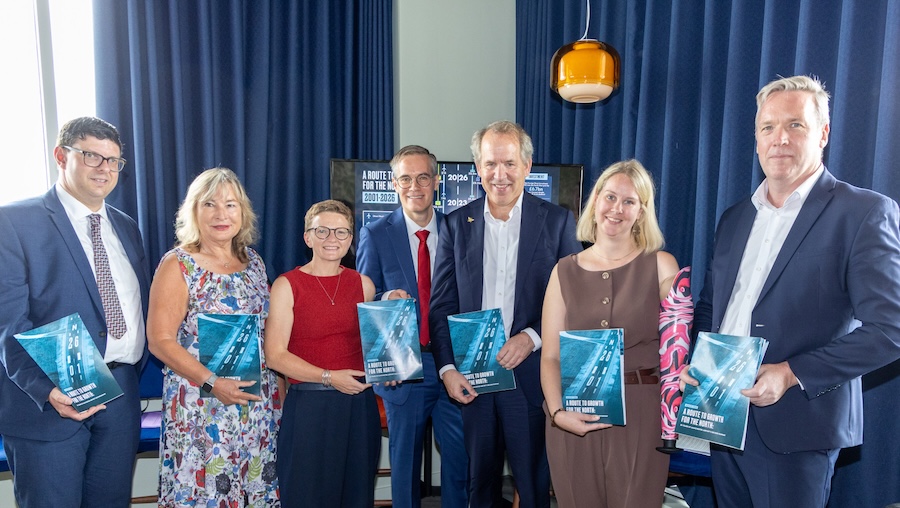

Manchester Airport’s second runway has played a major role in reshaping the economy of Northern England over the past 25 years, helping drive international investment, exports, tourism and academic collaboration, according to a new report.
The study, A Route to Growth for the North, was produced by economic consultancy Metro Dynamics to mark 25 years since Runway 2 opened in 2001.
The report estimates that Manchester Airport now generates an annual economic impact of £9.5 billion across the North, while connecting the region with markets representing around 75% of global GDP.
It argues that stronger rail links to the airport, particularly through Northern Powerhouse Rail, could extend those benefits further across Northern England.
Manchester Airport Runway 2 Marks 25 Years
Manchester Airport’s second runway opened in 2001 following a £172 million investment.
The project was completed just four years after receiving approval and was developed during a period when large parts of Northern England were recovering from decades of industrial decline.
Twenty-five years later, Manchester Airport handles around 32.3 million passengers annually and serves more than 200 destinations.
The report argues that the airport still has substantial spare capacity, with its two runways capable of supporting close to double today’s passenger numbers.
That additional capacity could provide further opportunities for new long-haul routes and stronger links between Northern businesses and international markets.
Foreign Investment and International Trade Grow Across the North
Economic analysis included in the report points to significant growth in international trade and investment across the North West and wider Northern economy.
Foreign direct investment into the North West increased by £6.7 billion over the past decade, despite a decline at UK level.
The value of international services trade in the North West rose by 48% between 2016 and 2023, reaching £59 billion.
More Northern Companies Are Trading Internationally
The number of North West businesses engaged in international trade increased from approximately 8,300 in 2011 to 13,100 in 2023.
Across the wider North, the value of goods trade increased by 66% between 2010 and 2025, compared with growth of 50% in London during the same period.
The report connects this growth with improved access to international markets from Manchester Airport.
International Tourism to the North West Surges
Tourism has also expanded strongly.
The North West recorded a 122% increase in international visitor numbers since 2022, which the report says was the strongest growth of any English region outside London.
VisitBritain CEO Patricia Yates said:
“Manchester Airport is a gateway to the North and a major driver of tourism growth across regional Britain. For many visitors, tourism is their first experience of a place, and regional gateways like Manchester Airport make it easier to discover more of Britain, underpinning our competitive tourism offer and message of welcome.
“By connecting international business and leisure visitors with destinations across the North, the airport supports local businesses, jobs and spending in communities far beyond its own doorstep, while positioning the North as a world-class destination for leisure, study, trade and investment.”
Academic Collaboration Increases Tenfold
The report also highlights the role international connectivity plays in higher education and research.
Global research collaborations involving the N8 group of Northern universities increased tenfold, reaching more than 70,000 over the 25-year period examined.
The airport argues that direct international connectivity is particularly important to research-intensive sectors such as life sciences, advanced manufacturing, digital technology and higher education.
Manchester Airport Calls for Northern Powerhouse Rail
While the report highlights the economic impact of Runway 2, its authors argue that better ground transport is needed if communities across the wider North are to benefit fully from Manchester Airport’s international network.
Northern Powerhouse Partnership life president Lord Jim O’Neill said:
“Manchester Airport was now an asset that benefits more than Greater Manchester alone. But that ambition needs to be matched by government investment in the transport links that connect the airport to the wider North.”
He added:
“The Northern economy is showing consistent signs of economic momentum, yet the airport’s potential catchment remains beyond easy reach. Northern Powerhouse Rail is the mechanism that changes that.”
According to O’Neill, improving rail access to the airport could support productivity growth across the wider region.
“If our new Prime Minister is to hit his target for UK growth, we need higher productivity overall, and that means closing the North-South divide. International connectivity can make a meaningful contribution to that, and in Greater Manchester’s case it already is. The missing piece is the railway that allows the rest of the North to fully share in those benefits.”
Greater Manchester Backs High-Speed Airport Rail Station
Greater Manchester Mayor Bev Craig also called for Northern Powerhouse Rail to include improved connections to Manchester Airport.
Craig said:
“Manchester Airport is Greater Manchester’s gateway to the world and one of the North’s great success stories. For 25 years, its second runway has helped connect our businesses, universities and communities to global markets, and has played a major role in our city-region’s reinvention.
“Now we need to make sure more people and places share in that success. Northern Powerhouse Rail, including a high-speed station at the airport, would cut journey times, open up access to jobs and opportunities, and help unlock the North’s full potential.”
Manchester Airport Economic Impact Reaches £9.5 Billion a Year
Manchester Airports Group CEO Ken O’Toole said the results demonstrate the wider economic impact that long-term infrastructure investment can deliver.
“This demonstrates clearly that when the right conditions are in place to encourage long-term investment in strategic infrastructure, the benefits are transformational and can power a generation of growth and beyond.
“Airports are not just buildings people pass through as they travel for work or leisure – they are a route to growth for regional economies – economic catalysts integral to our success as an island trading nation.”
O’Toole said investment in the airport’s runways and terminals had required long-term planning and cooperation between the public and private sectors.
“While Runway 2 shows what is possible, the UK’s overall performance on investment ranks poorly against other major economies. This Government has an opportunity to embed a policy environment that encourages key strategic investments just like this in regions across the UK, as part of its mission to deliver growth in every postcode.”
Northern Businesses Highlight Value of Global Connectivity
The report includes case studies from companies across Greater Manchester, Cheshire, Liverpool City Region, Cumbria and Yorkshire that rely on Manchester Airport to reach international customers.
Manchester-based life sciences company Qiagen, for example, has expanded its local workforce from 60 people in 2009 to more than 250 and now sells into 170 countries.
Julia Buckler, Head of Assay Development and Manchester Site Head at Qiagen, said:
“The scientific field as a whole is a global platform – and we all work together across those different countries. So the airport is essential for keeping those connections going. Business needs to connect. The easier you make it, the easier it is to go more frequently and the more it accelerates those collaborations.”
Expo Stars Interactive, another Manchester-based business, has supported more than 4,000 events across 53 countries.
Founder and Managing Director Lee Ali said:
“International connectivity is essential for northern businesses with global ambitions. Manchester Airport enables companies like ours to build relationships, reach new markets and export our expertise around the world without having to travel through London.”
Exporters Across Northern England Depend on International Routes
Similar examples appear throughout the report.
Cumbria-based Oxley Group exports more than 80% of its products to customers in 34 countries, while Yorkshire manufacturer John King Chains now generates almost half its turnover from exports across approximately 70 markets.
Leeds-based Sound Leisure exports around 70% of the jukeboxes it manufactures, while Huddersfield medical technology company Paxman trades in 65 countries.
In Cheshire, Hydraulics Online has exported equipment to more than 130 countries.
Co-founder Helen Tonks MBE said:
“Comprehensive long-haul routing of the kind Manchester Airport offers is a gamechanger for companies like ours when it comes to operating on a global stage. It means the world really can be our oyster.”
Report Sees Further Growth Potential for Northern England
The report argues that the 25-year development of Manchester Airport demonstrates the relationship between international transport infrastructure and regional economic growth.
Alongside increases in trade, tourism and foreign investment, the North West has also attracted substantial commercial development.
The region accounted for 19% of all new commercial land developed in England between 2017 and 2022, while industrial land values increased by 48% over the same period – the strongest rise outside London.
With Manchester Airport still having significant capacity for additional passengers and routes, the report concludes that the next stage of growth will depend partly on improving transport links between the airport and cities across Northern England.
Its central argument is that Manchester’s second runway has already helped create a more internationally connected Northern economy, but better rail infrastructure could allow a much larger part of the region to benefit from that connectivity over the coming decades.